How to Write Scenarios for K-12 Education
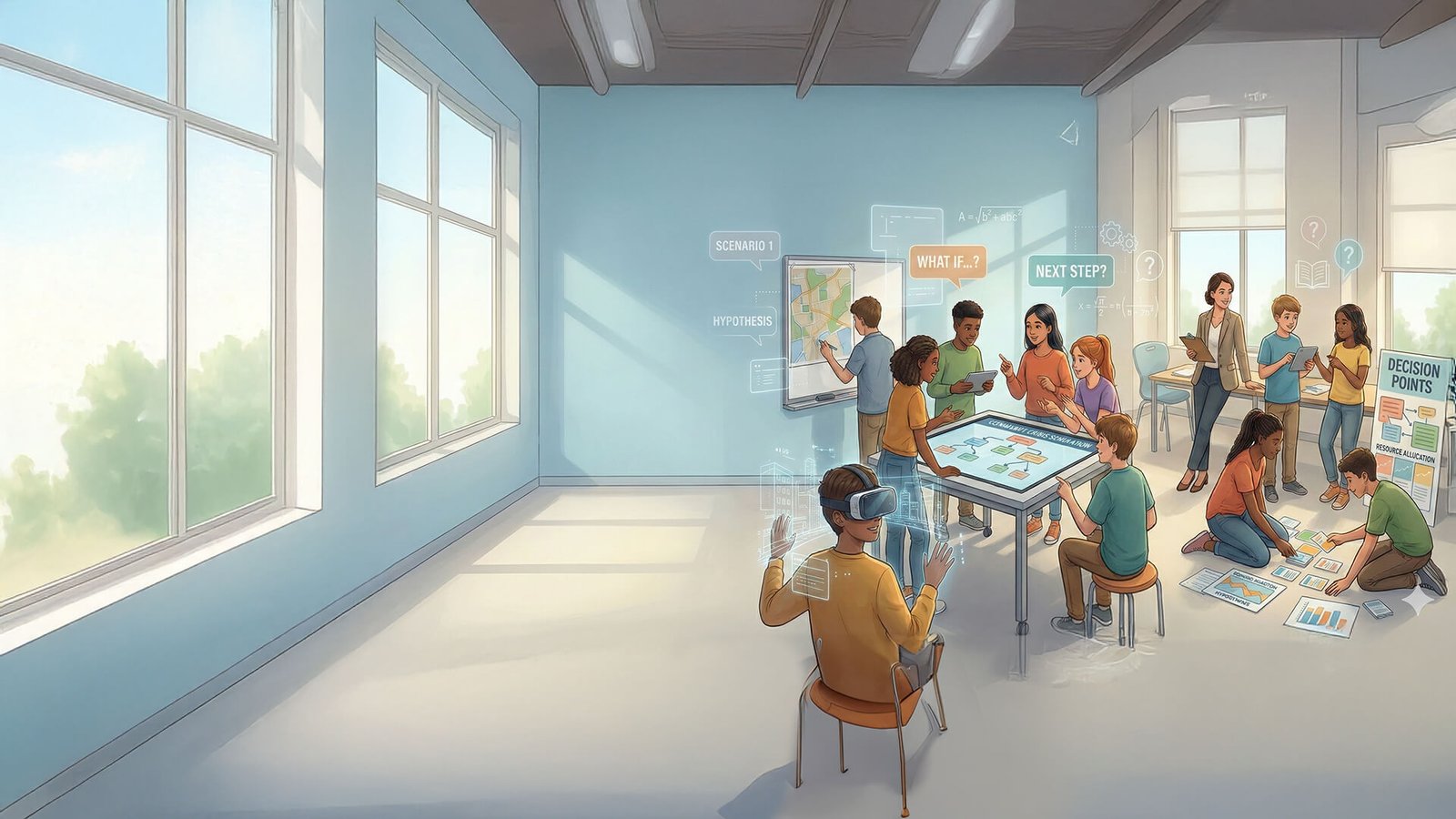
Scenario-Based Learning (SBL) is an instructional strategy that uses realistic, problem-focused narratives to engage learners, foster critical thinking, and facilitate the application of knowledge. Unlike traditional question-and-answer formats, SBL immerses the student in a contextualized situation, demanding they make decisions and face consequences, thereby bridging the gap between theoretical knowledge and real-world application.
In the K-12 environment, SBL is particularly potent because it directly addresses the challenges of student engagement, abstract concepts, and the development of 21st-century skills (critical thinking, collaboration, creativity, and communication).
This article serves as a roadmap for Instructional Designers, educators, and curriculum developers, detailing the theoretical foundation, structured design process, and practical techniques required to write effective, high-impact scenarios across all K-12 grade levels.
I. Why Scenarios Work in K-12
Effective scenario writing is not intuitive; it is rooted in established pedagogical and cognitive theories that explain how students learn best.
A. Constructivism and Authentic Learning
- Core Principle: SBL aligns perfectly with Constructivism, the theory that learners construct knowledge actively by integrating new information with existing understanding and experiences. Scenarios provide the “construct”—the relevant context—for this integration.
- Authentic Tasks: Scenarios present authentic tasks, meaning the problem closely mimics the cognitive and physical demands of real-world situations (e.g., historical debate, scientific investigation, ethical dilemma). This makes learning more meaningful and transferrable.
B. Cognitive Load Theory (CLT) and Contextualization
- The Problem: Traditional instruction often overloads students’ limited working memory with excessive, uncontextualized information (extraneous cognitive load).
- The Scenario Solution: Scenarios manage cognitive load by providing contextual cues and relevant constraints. By framing the information around a specific, immediate problem (e.g., “You are a city planner deciding on a budget”), the scenario focuses attention, reducing extraneous load and concentrating effort on the essential skill needed to solve the problem (germane cognitive load).
C. Situated Cognition and Transfer
- Core Principle: Situated Cognition holds that knowledge is best acquired and recalled in the context in which it will be used. Abstract knowledge, learned in isolation, often fails to transfer to new situations.
- Transfer Mechanism: SBL places the knowledge (e.g., a math formula, a grammar rule) inside a relatable context (e.g., a financial budget, writing an email to a potential employer). This linkage ensures that when the student encounters a similar problem in the real world, the relevant knowledge is more easily retrieved.
II. Design Framework: Mapping to Grade Levels
A strong scenario must be appropriately scaled to the learner’s developmental stage, following a structured design framework.
A. The ADDIE Framework and SBL
Scenario writing fits primarily into the Design (D) and Development (D) phases of the ADDIE model:
| 1 | Analysis (A) | Identify the Performance Gap (what skill is missing?) and the Learner Profile (age, prior knowledge, cognitive capacity). This is the most critical step. |
| 2 | Design (D) | Write the Terminal Objective (the final, measurable outcome) and the Scenario Blueprint (the decision points, characters, and plot). |
| 3 | Development (D) | Write the narrative, multimedia scripts, and feedback loops. |
| 4 | Implementation (I) | Deliver the scenario (e.g., classroom role-play, digital simulation). |
| 5 | Evaluation (E) | Assess the decision-making process and final outcome. |
B. Scenario Scaling Across K-12
Scenarios must be scaled based on the student’s cognitive maturity, ability to handle complexity, and experience with ambiguity.
| Grade Level | Cognitive Focus | Scenario Type | Required Scaffolding |
| K-5 (Elementary) | Concrete, Single-Concept. Focus on emotional and social skills, foundational literacy, and numeracy. | Micro-Scenarios/Role-Play. Short narratives with 1-2 clear decision points. Focus on immediate, visible consequences. | Heavy guidance, visual aids, immediate feedback from the instructor. Limited ambiguity. |
| 6-8 (Middle School) | Conceptual, Cause-and-Effect. Introduce abstract concepts and multi-step processes. Focus on problem identification. | Short Case Studies. 3-5 decision points. Focus on analyzing different sources of information and ethical implications. | Moderate. Provided resources (articles, data sets) but student must select the relevant ones. |
| 9-12 (High School) | Abstract, Systems Thinking. Focus on complex real-world systems, policy, and long-term implications. | Complex Simulations/Projects. Open-ended problems, multiple variables, collaborative roles. No single “right” answer. | Minimal. Student must define the problem, locate external resources, and justify a multi-faceted solution. |
III. Step-by-Step Guide to Scenario Writing
The process of writing a high-impact scenario can be broken down into six structured steps, moving from objective setting to narrative refinement.
Step 1: Define the Performance Objective (The “Do”)
The scenario must be designed to test the student’s ability to do something specific, not just know something.
- Terminal Objective (What): Start with the end goal. What must the student demonstrate? (e.g., “The student will correctly apply the formula for calculating volume to determine the needed amount of concrete.”)
- Enabling Objectives (How): What prerequisite knowledge is required? (e.g., “The student can identify the correct formula; the student can measure object dimensions.”) The scenario will test the terminal objective but may provide resources for the enabling objectives.
Step 2: Identify the Context and Constraints (The “Why”)
The context provides the relevance (the WIIFM) and the constraints make the problem realistic.
- Context/Setting: Choose a setting that is authentic and relatable to the grade level (e.g., Middle School: planning a school event budget; High School: advising a local government committee).
- The Conflict: Establish the core problem. The scenario must present a conflict—a choice between two or more valid, yet imperfect, options. If the choice is obvious, it is not a scenario; it is a quiz.
- Example Conflict: Choosing the fastest chemical process vs. the process that generates the least amount of hazardous waste.
- Constraints: Define the non-negotiable limitations: time, budget, resource availability, ethical rules, or physical laws. Constraints force the student to prioritize.
Step 3: Develop the Core Narrative and Character Roles (The “Who”)
The narrative transforms an abstract problem into an engaging, emotional experience.
- The Protagonist (The Student): Clearly define the student’s role. The scenario is more powerful when the student has a role of consequence (e.g., Lead Engineer, Chief Reporter, Mayor).
- The Supporting Cast: Introduce characters who provide necessary information (SME role) or act as stakeholders who will react to the decision (conflict role).
- Tone: The narrative must match the subject matter. A science scenario might be suspenseful (saving a town from pollution), while a history scenario might be challenging (writing a persuasive speech under duress).
Step 4: Write the Decision Points and Feedback Loops
The quality of the scenario rests entirely on the quality of its decision points and subsequent feedback.
- The Hook: The scenario must begin with a compelling narrative hook that immediately presents the problem and the stakes.
- Decision Points: These are the moments where the student must apply the objective. Each decision point should be followed by immediate consequence feedback.
- Avoid: “Is A the right answer?”
- Use: “You choose option B. As a result, your team now has a three-day delay and has exceeded the budget by 15%. What is your next move?”
- Feedback: Feedback must be consequential, non-judgmental, and diagnostic. It explains why a choice was good or bad in the context of the narrative, forcing the student to reflect and iterate.
Step 5: Incorporate Scaffolding and Resources
Scaffolding ensures that the scenario is challenging but not overwhelming, especially for younger learners.
- K-5 Scaffolding: May involve color-coding options, providing a pre-written dialogue script for role-play, or supplying the formula directly before the application step.
- 9-12 Scaffolding: Focuses on resource selection. The student may be provided with a link to a database, three contradictory articles, or raw data, and their challenge is selecting which resource is relevant and credible to inform their decision.
Step 6: Refine, Review, and Pilot
Once drafted, the scenario must be tested for technical and pedagogical validity.
- Technical Review: Check for clarity, ambiguity, and flow. Does the narrative make sense? Are the consequences logical? Are the constraints clear?
- SME Review: Have a Subject Matter Expert (teacher or expert in the field) verify the accuracy of the content and the validity of the decisions/consequences.
- Pilot: Test the scenario with a small group of students from the target grade level. Observe where they get stuck (indicating poor scaffolding) or where they guess (indicating poor conflict design).
IV. Practical Application and Integration across Subject Areas
Scenarios are versatile tools that can be adapted to almost any subject, requiring only a shift in the nature of the conflict.
A. Science, Technology, and Mathematics (STEM)
- Focus: Testing the application of procedures, formulas, and scientific method in a dynamic environment.
- Scenario Example (Grade 10 Physics):
- Context: You are the engineer in charge of setting up a new roller coaster. You must calculate the maximum height of the first hill to ensure the car reaches the top of the second, smaller hill, while adhering to a maximum deceleration constraint for rider safety.
- Conflict: Balancing kinetic energy calculation with safety constraint (ethics).
- Assessment: The accuracy of the final calculation and the justification for the safety buffer.
B. History and Social Studies
- Focus: Testing analysis of primary sources, decision-making under historical constraints, and ethical reasoning.
- Scenario Example (Grade 8 History):
- Context: It is 1848, and you are a newspaper editor in a frontier town during a gold rush. You have received three conflicting reports regarding a recent land dispute between miners and a Native American tribe. You have a print deadline in 3 hours.
- Conflict: Choosing between running a highly inflammatory, unverified story (high sales) or a nuanced, verified story (low sales), while considering the ethical consequences to the community.
- Assessment: The student’s analysis of the credibility of the primary sources and the justification of their decision using established journalistic ethics.
C. Language Arts and Literacy (ELA)
- Focus: Testing communication skills, persuasive writing, tone, and character analysis.
- Scenario Example (Grade 11 ELA):
- Context: You are the author’s publicist. Your author has just been accused of plagiarism due to a perceived similarity between their novel and a classic work. You must craft two pieces of communication: a private, defensive email to the author, and a public, official statement to the press.
- Conflict: Applying different rhetorical strategies and tones (defensive vs. confident) to distinct audiences while maintaining factual consistency.
- Assessment: The rhetorical effectiveness, clarity, and tone control demonstrated in the two different communication pieces.
V. Advanced Strategies: Multimedia, Interactivity, and AI
To sustain engagement in the modern classroom, scenarios must leverage advanced instructional techniques.
A. Utilizing Multimedia for Immersion
- Visual Context: Use maps, architectural blueprints, infographics, and short video clips to set the scene and present data that students must analyze.
- Audio/Video Scaffolding: Record short “expert interviews” (SME voices) or “urgent phone calls” (protagonist’s supervisor) to deliver information mid-scenario, increasing realism and managing the flow of content.
- Interactive Tools: Use branching scenario software (like Twine or proprietary EdTech platforms) to create non-linear narratives where choices lead the student down entirely different narrative paths.
B. The Power of Collaborative Scenarios
In High School, scenarios can be designed to foster essential collaboration and teamwork skills:
- Role Assignment: Assign students distinct roles (e.g., the Historian, the Budget Analyst, the Communications Lead) that grant them access to unique, non-sharable information.
- Mandated Collaboration: The scenario’s solution requires the team to negotiate and synthesize their unique pieces of information, replicating the complexity of real-world teams where information is distributed and conflicting.
- Assessment: Evaluation focuses on the quality of the team’s negotiation, documentation of the decision process, and final justification, not just the correct final answer.
C. Leveraging AI for Scenario Generation (The Future Role)
While AI cannot replace the ID’s analysis, it can significantly accelerate the Development phase:
- Instant Context Generation: AI can rapidly generate narrative text, character dialogue, and initial drafts of conflict scenarios based on a set of ID-defined constraints (e.g., “Create a scenario for a 9th-grade biology class focused on genetic mutation, set it on a fictional Martian colony, and include a budget constraint”).
- Drafting Assessment Questions: AI can draft consequential feedback loops and multiple-choice assessment questions related to the scenario’s decision points.
- The ID’s Role: The Instructional Designer must remain the strategic architect, reviewing AI-generated content for pedagogical validity, alignment to the objective, and freedom from ambiguity. The ID ensures the scenario is testing the skill, not just narrating the skill.
VI. Overcoming Common Challenges in K-12 Scenario Writing
Even the most well-designed scenarios can fail if common pitfalls are not addressed.
A. The Ambiguity Challenge
- Pitfall: Writing scenarios that are so vague or open-ended that students feel lost, leading to frustration and cognitive overload.
- Solution: Define clear boundaries and goals. For K-5, clearly state the options. For 9-12, explicitly state the criteria for success (e.g., “Your final proposal must not exceed $50,000 and must be supported by two distinct data sources”).
B. The “Too Much Narrative” Challenge
- Pitfall: Focusing too much on descriptive storytelling, leading the student to miss the core instructional point or the critical data needed for the decision.
- Solution: Conciseness and Highlighting. Ensure the Decision Point and all essential information (data, rules, constraints) are clearly highlighted, perhaps using distinct formatting or a separate “Data Packet” resource. The narrative must serve the learning, not overwhelm it.
C. The “Single Right Answer” Challenge
- Pitfall: Designing a scenario where the consequences of one choice are so obviously disastrous that the scenario reverts to a multiple-choice quiz.
- Solution:Introduce Trade-offs and Imperfection. Make all viable options come with a cost.
- Example: Option A is ethical and cheap but slow. Option B is fast and profitable but carries a high environmental risk. This forces genuine critical thinking and justification.
Scenario-Based Learning as the Future of K-12
Scenario-Based Learning is indispensable for K-12 education, moving the classroom experience beyond rote memorization to skill application.
Success requires a deep understanding of the learner’s cognitive and developmental stage, a commitment to rigorous analysis, and the skill to craft compelling, authentic conflicts that force students to transfer abstract knowledge into tangible, justifiable decisions. By systematically applying the principles of SBL, educators can unlock the potential for truly deep learning, preparing students not just for the next test, but for the complex, ambiguous challenges of the 21st century.