

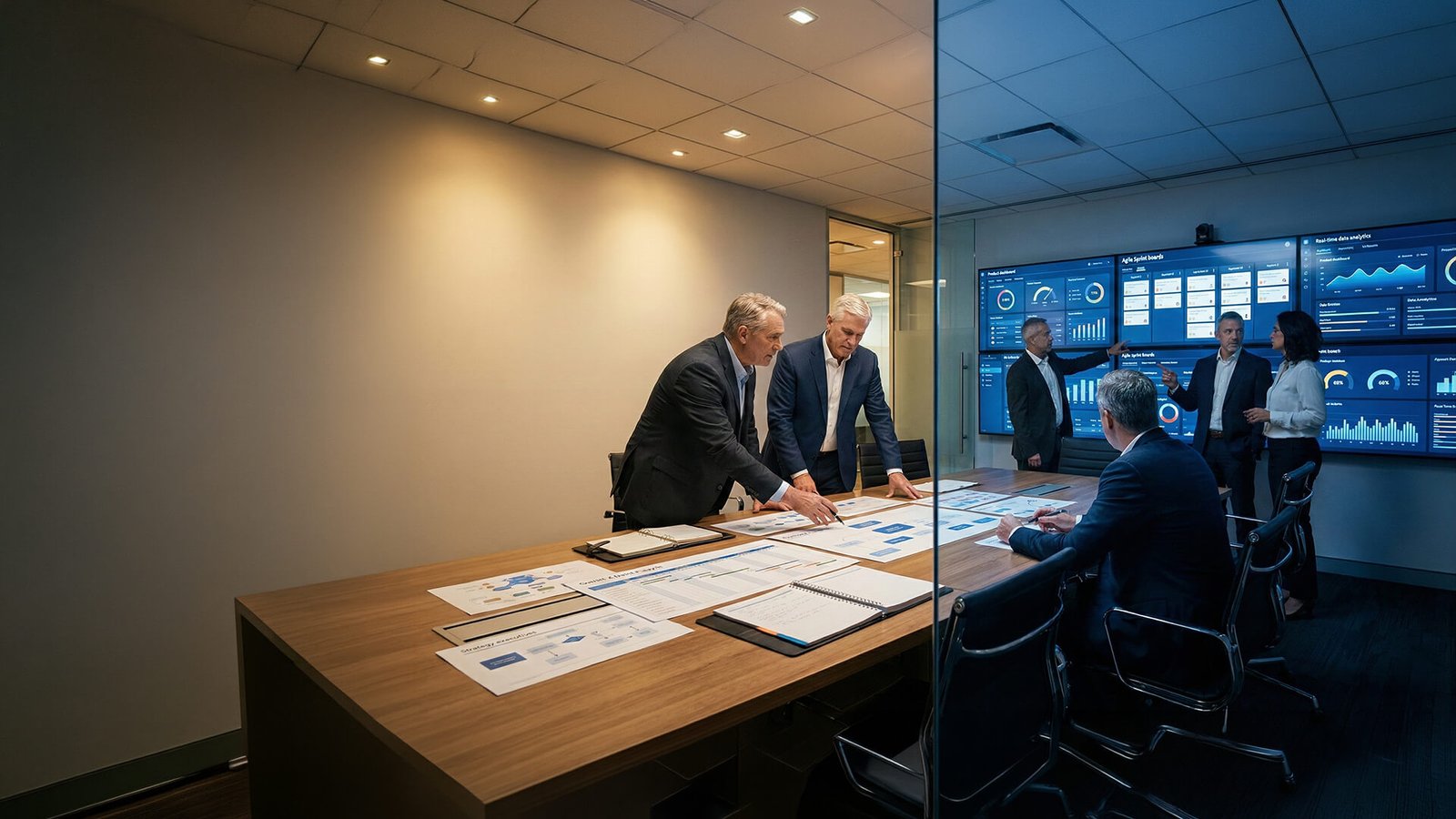
Prosci vs Agile / Product-Led Change: A Critical Comparison
For years, organizations treated change management and delivery as separate concerns:
- Projects delivered solutions
- Change management “prepared people”
That separation is collapsing.
AI, digital platforms, and product operating models have:
- Shortened feedback cycles
- Made adoption measurable in real time
- Shifted power from programs to products
- Reduced tolerance for indirect value
As a result, two paradigms now collide:
- Prosci-style change management (structured, people-centered, plan-driven)
- Agile / product-led change (continuous, embedded, usage-driven)
Most organizations blend them badly, misunderstand the trade-offs, and then blame “change fatigue” when results disappoint.
1. Core philosophy: planned transition vs continuous evolution
Prosci: Change as a managed transition
Prosci is built on a transition mindset:
- There is a current state
- There is a future state
- People must be guided across the gap
Change is treated as:
- A discrete event
- With a beginning, middle, and end
- Supported by structured interventions
This works well when:
- The future state is known
- The solution is relatively stable
- The organization values predictability
Underlying assumption:
If we manage awareness, desire, knowledge, ability, and reinforcement, adoption will follow.
Agile / Product-Led: Change as continuous adaptation
Agile and product-led models assume:
- The future state is not fully knowable
- Value emerges through iteration
- Learning happens through usage, not preparation
Change is:
- Ongoing
- Embedded in delivery
- Measured through behavior and outcomes
Underlying assumption:
If the product delivers value, people will adapt — and if they don’t, the product is wrong.
This is a fundamentally different worldview.
2. Unit of change: individuals vs systems
Prosci: Individual change as the primary unit
Prosci’s ADKAR model focuses on individual adoption:
- People must understand
- People must choose to support
- People must learn and sustain
Strength:
- Deep insight into human psychology
- Strong guidance for manager and sponsor behavior
- Effective in high-impact, role-changing initiatives
Limitation:
- Places heavy responsibility on people to adapt
- Can underplay poor system design
- Scales poorly in fast-moving environments
Critical issue:
Prosci often treats systems as neutral and people as the variable — when in digital environments, the opposite is often true.
Agile / Product-Led: Systems shape behavior
Agile and product-led models treat systems, workflows, and incentives as the primary drivers of behavior.
Key belief:
People do what the system makes easy, not what the change plan encourages.
Strength:
- Forces accountability onto design
- Reduces reliance on persuasion
- Makes adoption measurable and testable
Limitation:
- Can underplay emotional, identity, and power dynamics
- Assumes rational behavior where fear or loss exists
- Struggles with large-scale workforce displacement
In short:
- Prosci humanizes change
- Product-led change mechanizes it
Both miss things when used alone.
3. Role of leadership and sponsorship
Prosci: Sponsorship as a central pillar
Prosci research consistently shows sponsorship as the single most important success factor.
Sponsors are expected to:
- Communicate the why
- Build coalitions
- Reinforce change over time
Strength:
- Makes leadership accountability explicit
- Prevents “delegated change”
- Works well in hierarchical organizations
Limitation:
- Assumes leaders have time, skill, and credibility
- Breaks down when sponsorship is symbolic
- Slows in distributed, product-centric orgs
Reality:
Many Agile organizations fail Prosci sponsorship criteria by design — and don’t care.
Agile / Product-Led: Leadership through prioritization
In product-led environments, leadership shows up less through messaging and more through:
- Funding decisions
- Backlog prioritization
- Metrics selection
- Tolerance for failure
Leadership question shifts from:
“Are leaders visible?”
to:
“What does the system reward?”
Strength:
- Harder to fake
- Directly tied to value creation
- Scales better across teams
Limitation:
- Less explicit people leadership
- Can feel cold or indifferent
- Leaves gaps during emotionally disruptive change
4. Planning vs emergence
Prosci: Plan-driven change
Prosci emphasizes:
- Change strategies
- Communication plans
- Training plans
- Resistance management plans
Strength:
- Predictable
- Reassuring to risk-averse organizations
- Useful in regulated environments
Limitation:
- Assumes stability
- Struggles when requirements change
- Can become performative rather than adaptive
In fast-changing environments, plans age quickly — but organizations still execute them out of habit.
Agile / Product-Led: Change through feedback loops
Agile change relies on:
- Short iterations
- Usage data
- Continuous feedback
- Rapid adjustment
Strength:
- Responds quickly to reality
- Surfaces problems early
- Reduces sunk-cost bias
Limitation:
- Can feel chaotic
- Difficult for compliance-heavy contexts
- Often underinvests in sense-making
Key risk:
Agile can mistake speed for alignment.
5. Measurement: sentiment vs behavior
Prosci: Adoption readiness and reinforcement
Prosci measures:
- Awareness
- Desire
- Adoption levels
- Sustainability indicators
Strength:
- Focuses on leading indicators
- Highlights risk early
- Captures human signals data misses
Limitation:
- Often subjective
- Weakly tied to business outcomes
- Easily deprioritized by executives
Agile / Product-Led: Usage and value metrics
Product-led change measures:
- Active usage
- Retention
- Cycle time
- Productivity
- Revenue or cost impact
Strength:
- Objective
- CFO-aligned
- Hard to argue with
Limitation:
- Lagging for human impact
- Can miss burnout or trust erosion
- Treats non-usage as a product failure even when incentives are misaligned
6. Speed vs stability trade-off
Prosci excels when:
- Change is episodic
- Risk tolerance is low
- Workforce impact is high
- Regulatory scrutiny is strong
- The future state is largely known
Agile / Product-Led excels when:
- Change is continuous
- Technology is central
- Feedback loops are short
- Teams are autonomous
- Value is uncertain upfront
The mistake organizations make:
They apply Prosci to Agile environments
and Agile thinking to Prosci-style transformations
Both fail when misapplied.
7. Power dynamics and resistance
Prosci: Resistance as a signal to manage
Prosci treats resistance as:
- Predictable
- Manageable
- Often rational
This leads to:
- Targeted interventions
- Manager coaching
- Communication refinement
Strength:
- Prevents dismissive leadership behavior
- Preserves trust
Limitation:
- Can legitimize resistance that protects obsolete roles
- Slows necessary disruption
- Assumes compromise is always possible
Agile / Product-Led: Resistance as data
Product-led change treats resistance as:
- A signal of poor design
- Or misaligned incentives
If people don’t adopt:
- Fix the product
- Or remove the constraint
Strength:
- Ruthlessly pragmatic
- Reduces political theater
Limitation:
- Can ignore real loss and fear
- Risks silent disengagement
- Can damage long-term trust
8. The AI effect: where both are being stress-tested
AI exposes weaknesses in both models.
Prosci under AI pressure
- Too slow for AI iteration cycles
- Over-relies on training where AI reduces learning need
- Struggles when roles disappear rather than change
Agile under AI pressure
- Can underestimate ethical, trust, and workforce risk
- Assumes adaptability where displacement occurs
- Often lacks governance and accountability clarity
AI-era change requires:
- Product-led speed
- Prosci-level human judgment
- Financial accountability
- Clear decision authority
Neither model alone is sufficient.
9. The emerging hybrid (what actually works)
High-performing organizations increasingly do the following:
- Use product-led delivery to drive adoption
- Use Prosci selectively for:
- Sponsorship
- Manager enablement
- High-impact role transitions
- Risk-heavy changes
Change is no longer a standalone function.
It is:
- Embedded
- Outcome-owned
- Selectively human-centered
The future is not Prosci or Agile.
It is economic accountability with human intelligence.
Conclusion: Stop arguing frameworks, start matching context
Prosci and Agile / product-led change are not enemies.
They are answers to different problems.
Prosci fails when:
- Speed matters more than comfort
- Systems drive behavior
- Value is uncertain
Agile fails when:
- People lose power, identity, or jobs
- Risk tolerance is low
- Trust must be actively managed
The real failure is not choosing the “wrong” model.
It is refusing to adapt your change approach to the economics, technology, and risk profile of the moment.




wish you best and best